
In the late 1600s, the Mughal Empire was the richest on earth. It controlled 25% of the world’s wealth. But Emperor Aurangzeb made a fatal mistake. He spent 27 years fighting endless foreign wars.
To pay for his military, he squeezed his citizens dry. He raised taxes to crushing levels. He destroyed the agricultural base that made the empire strong. The farmers could no longer afford to produce. The treasury bled dry, and the empire collapsed. It did not fall to a stronger army. It fell because it destroyed its own producers to pay its debts.
History is repeating itself right now.
The U.S. national debt just crossed $39 trillion. The government is paying over $1.2 trillion a year just in interest. At the same time, the country is burning $1 billion to $2 billion every single day on foreign conflicts. Oil has surged past $106 a barrel.
Who pays for this? You do. You pay for it through inflation at the grocery store. You pay for it at the gas pump. You pay for it when supply chains break down and basic goods become too expensive to buy.
When an empire is drowning in debt, the people who survive are the ones who stop relying on the empire. They stop buying and start making. They build decentralized production right in their own backyards.
Here is how you can build a debt-proof homestead and take back control of your basic needs.
1. The Debt-Proof Garden: Grow Your Own Calories
When inflation hits, food is the first thing to get expensive. The best way to fight back is to grow your own calories. You do not need a massive farm. You just need to focus on crops that give you the most energy for the least amount of work.
| Action Category | Practical Details |
|---|---|
| Real Steps | Stop planting just lettuce and tomatoes. Plant calorie-dense crops like potatoes, beans, corn, and winter squash. Save your seeds by buying heirloom, open-pollinated varieties so you can harvest the seeds at the end of the season and plant them again next year. Build healthy soil using compost from your own kitchen scraps and yard waste. |
| Real Costs | Heirloom seed bundle: $40 – $80. Basic compost bin setup: $0 (use scrap wood) to $50. Total investment: Under $130. |
| Real Tools | A sturdy broadfork or digging fork, a heavy-duty hoe, and seed starting trays. |
If you want to maximize your food production in a small space, check out our sister site, 4ft Farm Blueprint, for guides on high-density planting.
2. The Backyard Meat Supply: Small-Scale Protein
Meat prices are climbing fast. Relying on the grocery store for your protein is a huge risk. You can take control by raising small livestock that convert feed into meat very efficiently.
| Action Category | Practical Details |
|---|---|
| Real Steps | Start with meat rabbits or quail. They take up very little space, are quiet, and reproduce quickly. Build secure, predator-proof housing using hardware cloth, not chicken wire, to keep predators out. Learn how to process the meat yourself, as it is a vital skill that saves you money and ensures your food is handled cleanly. |
| Real Costs | Breeding trio of rabbits (1 buck, 2 does): $60 – $100. Materials for a sturdy hutch: $100 – $150. Initial feed and waterers: $40. Total investment: $200 – $290. |
| Real Tools | Heavy-duty wire cutters, J-clip pliers for building cages, and a sharp, high-quality processing knife. |
3. The Home Apothecary: Make Your Own Remedies
When the Mughal Empire fractured, trade routes broke down. Medicine and spices stopped flowing. Today, our medical supply chain is incredibly fragile. Many basic medicines are made overseas. When shipping costs rise, medicine gets scarce.
| Action Category | Practical Details |
|---|---|
| Real Steps | Grow basic medicinal herbs like calendula, echinacea, peppermint, and yarrow, which are easy to grow and thrive in poor soil. Learn to make simple salves by infusing the herbs in a carrier oil (like olive oil) for a few weeks, then melting the oil with beeswax. Make tinctures using high-proof alcohol to extract the active compounds from your herbs. |
| Real Costs | Medicinal herb seeds: $20 – $30. Carrier oils and beeswax: $30. Mason jars for infusing: $15. Total investment: $65 – $75. |
| Real Tools | Glass Mason jars, cheesecloth or a fine mesh strainer, and a double boiler (or a glass bowl over a pot of water). |
4. The Off-Grid Pantry: Preserve What You Produce
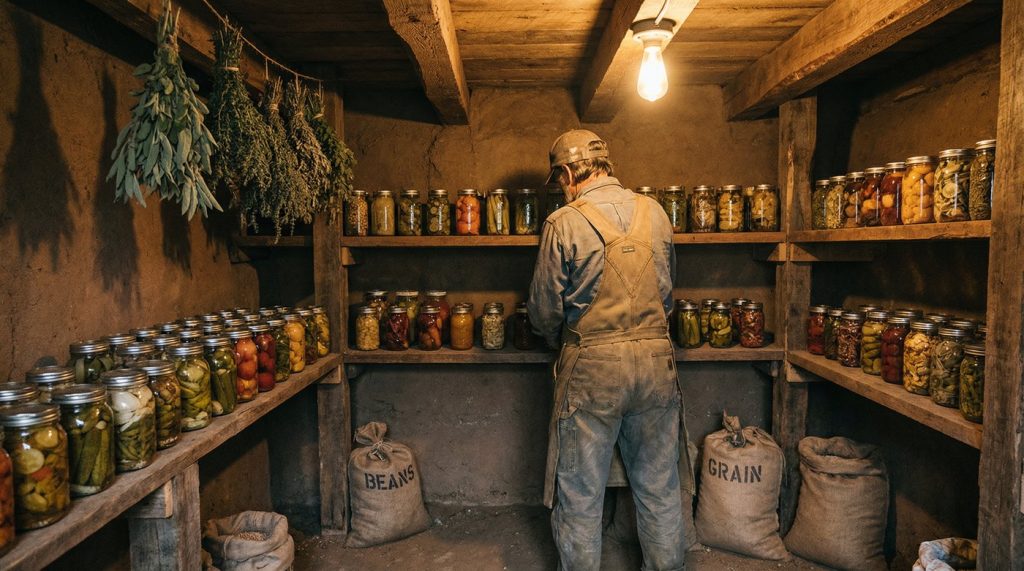
Growing food is only half the battle. If you cannot preserve it without electricity, you are still vulnerable. You need to build a pantry that does not rely on a freezer.
| Action Category | Practical Details |
|---|---|
| Real Steps | Learn to pressure can, as this is the only safe way to preserve low-acid foods like meat, beans, and vegetables. Dehydrate your harvest using a solar dehydrator or a simple electric one to dry fruits, herbs, and jerky. Water glass your eggs, an old-fashioned method that uses pickling lime and water to keep fresh, unwashed eggs good for up to a year at room temperature. |
| Real Costs | Quality pressure canner: $100 – $150. Canning jars and new lids: $40 – $60. Pickling lime for eggs: $15. Total investment: $155 – $225. |
| Real Tools | A 23-quart pressure canner, a jar lifter and canning funnel, and food-grade buckets for water glassing. |
Your Homestead is Your Shield
The Mughal Empire collapsed because it taxed its producers into the ground to pay for endless wars. The U.S. is walking the exact same path. The debt is spiraling, and the costs are being passed down to you.
But you do not have to go down with the ship. Every seed you plant, every tool you master, and every jar you can is a step toward true independence. Real wealth is not what you can buy. Real wealth is what you can produce yourself.
Start building your debt-proof homestead today.
Take the Next Step:
If you want to ensure your family is fully prepared for the coming economic shifts, you need a comprehensive plan. Check out the Noah’s Ark Survival Blueprint to learn how to secure 40 gallons of water a day and build a resilient homestead system.
And if you are worried about how the $39 trillion national debt will impact your retirement savings, do not wait until it is too late. Get your FREE Special Report from GoldCo: How To Survive The Next Financial Crisis and learn how to protect your assets today.