
A thousand years ago, the Vikings built the most expansive global network the world had ever seen. They traded from North America to Baghdad. They served as elite guards for emperors. They ruled a massive empire spanning multiple countries.
And then, they just stopped.
They weren’t conquered. They weren’t defeated in some massive, world-ending war. They simply chose to stop reaching outward. They pulled back. They assimilated. They walked away from the global stage.
And the world didn’t wait for them to return. It moved on. The trade routes were filled by others. The colonies they left behind withered and died, cut off from the supply chains they had come to rely on.
Does this sound familiar?
In early 2026, America is making the exact same choice. We’ve withdrawn from 66 international organizations. We’ve slashed foreign aid. We’re pulling back from the global stage. And just like a thousand years ago, the world isn’t waiting. Other powers are stepping in to fill the void.
But here is the most important lesson from the end of the Viking Age: The people who survived the collapse of that massive network were not the ones who sat around waiting for the longships to return with supplies.
The survivors were the ones who built local resilience. They were the ones who knew how to grow, preserve, and store their own food.
Real wealth isn’t a global supply chain that a single diplomatic withdrawal can sever. Real wealth is the land under your feet and the tools in your hands.
If you want to survive the great abdication of the modern era, you need to stop relying on the grocery store. You need to build your own food sovereignty. And the best way to do that is by building a modern root cellar.
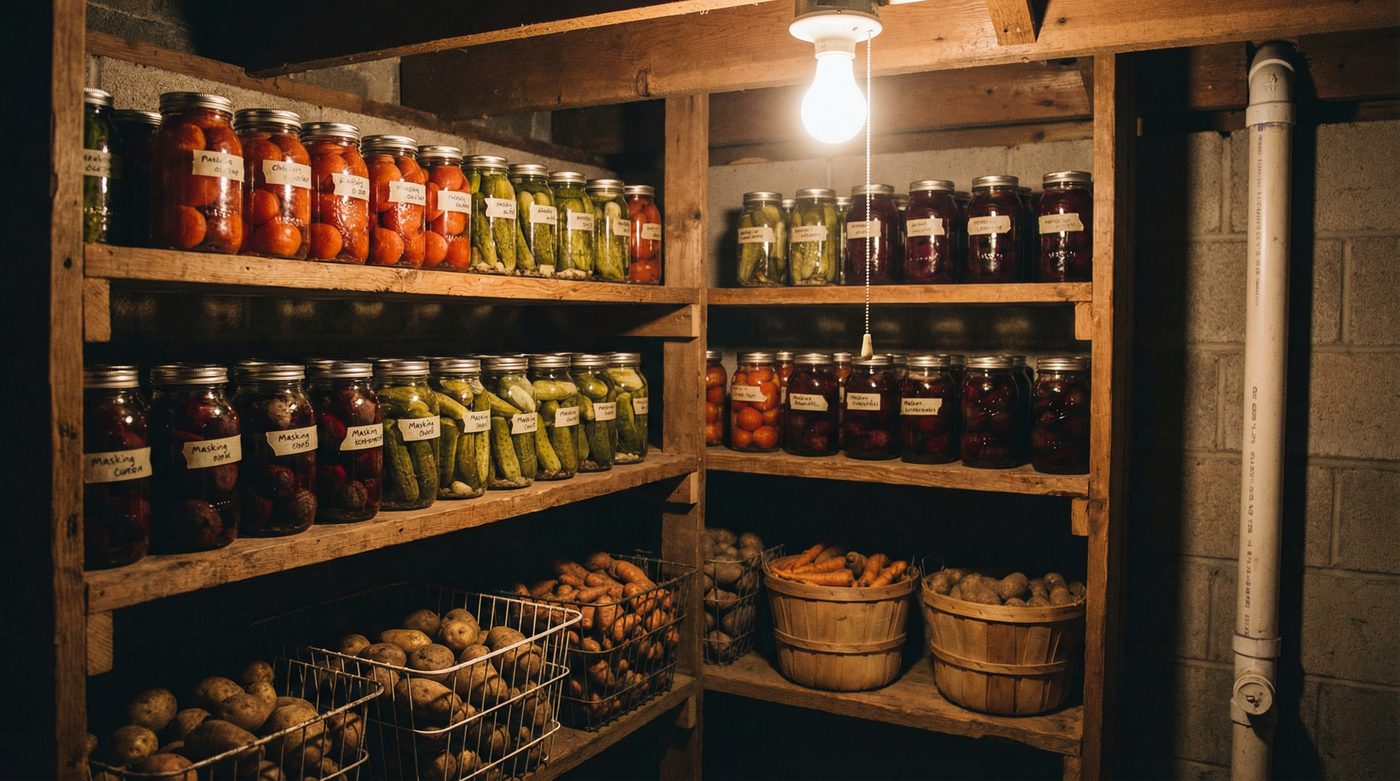
Why You Need a Root Cellar Right Now
When the global supply chain breaks down, the grocery store shelves empty in days. We’ve seen it happen before, and we’ll see it happen again.
A root cellar is the ultimate hedge against this fragility. It requires no electricity. It requires no replacement parts. It just uses the natural insulating properties of the earth to keep your food fresh for months.
It is the exact kind of decentralized production that outlasts empires.
Here is how you can build a basic, highly effective root cellar on your own property, without spending a fortune.
Tier 1: The Buried Trash Can Cellar (Cost: $30 – $50)
If you have zero budget and very little space, you can still build a functional root cellar in an afternoon.
What you need:
- A galvanized steel trash can with a tight-fitting lid (30-gallon size works best)
- A shovel
- Straw or dry leaves
- A heavy rock or cinder block
The Steps:
- Dig the Hole: Find a spot in your yard that is well-drained and preferably shaded. Dig a hole deep enough so that when you place the trash can inside, the rim is about 3 to 4 inches above the ground level.
- Place the Can: Set the trash can in the hole. Pack the dirt tightly around the outside of the can to secure it.
- Add Insulation: Place a thick layer of straw or dry leaves at the bottom of the can.
- Store Your Food: Layer your root vegetables (carrots, potatoes, beets) inside, separating the layers with more straw.
- Seal it Up: Put the lid on tight. Place a thick layer of straw over the top of the lid, and weigh it down with a heavy rock to keep animals out.
This simple setup uses the earth’s constant temperature to keep your harvest fresh well into the winter.
Tier 2: The Basement Corner Cellar (Cost: $150 – $300)
If you have an unfinished basement, you already have the perfect environment for a more substantial root cellar. You just need to isolate a corner to control the temperature and humidity.
What you need:
- 2×4 lumber for framing
- Rigid foam insulation board
- Plywood or oriented strand board (OSB)
- A pre-hung exterior door
- PVC pipe for ventilation
- Basic carpentry tools
The Steps:
- Choose the Corner: Pick a northeast or northwest corner of your basement. These are naturally the coolest spots.
- Frame the Walls: Build two stud walls to enclose the corner.
- Insulate: Fill the stud cavities with rigid foam insulation. You want to keep the heat of your house out of the cellar.
- Install the Door: Hang the exterior door. Make sure it has good weather stripping to maintain the seal.
- Ventilation is Key: This is the most critical step. You need two PVC pipes running to the outside. One pipe should drop down near the floor to bring in cool air. The other should be near the ceiling to exhaust warm, stale air.
- Add Shelving: Build sturdy wooden shelves to hold your jars and bins.
This setup gives you massive storage capacity and excellent control over the environment.
Tier 3: The Earthbag or Cinder Block Bunker (Cost: $800 – $2,000+)
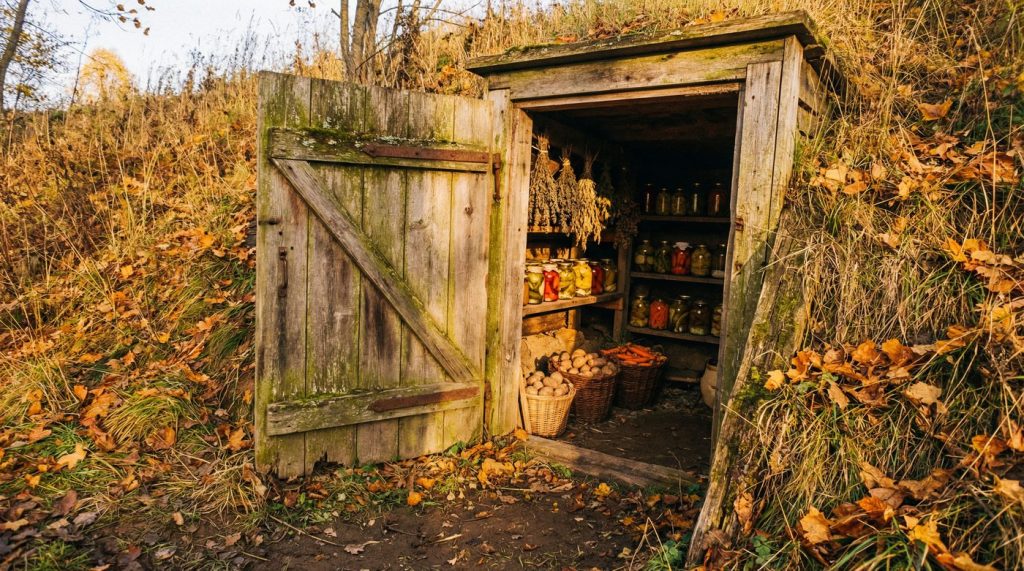
For the ultimate in food sovereignty, you want a dedicated, standalone structure built into the earth. This is a serious project, but it will last for generations.
What you need:
- A backhoe or excavator (rented)
- Cinder blocks and mortar OR earthbags (polypropylene bags filled with soil)
- Rebar and concrete for reinforcement
- Waterproofing membrane
- Heavy-duty ventilation pipes
- A sturdy, insulated door
The Steps:
- Excavation: Dig a large trench into a hillside or a deep hole in flat ground. You want the floor to be at least 6 feet below the frost line.
- Build the Walls: Construct the walls using cinder blocks (reinforced with rebar and concrete) or by stacking and tamping earthbags.
- Waterproof: Apply a heavy-duty waterproofing membrane to the outside of the walls before backfilling. Moisture is the enemy of a root cellar.
- The Roof: Build a reinforced roof capable of holding several feet of earth.
- Ventilation: Install intake and exhaust pipes, just like the basement cellar.
- Backfill: Cover the structure with earth, leaving only the doorway and vents exposed.
This is the kind of structure that the Norse settlers of Iceland would have recognized and respected. It is permanent, off-grid, and completely under your control.
Your Homestead is Your Empire
The empires of the world will rise and fall. They will expand, and they will abdicate. You cannot control what happens in Washington, or Beijing, or Geneva.
But you can control what happens on your own land.
When you build the capacity to feed yourself, you stop being a dependent subject of a fragile system. You become a sovereign citizen of your own homestead.
Don’t wait for the supply chains to break. Don’t wait for the longships to stop coming. Start building your resilience today.
Ready to take your self-reliance to the next level?
If you want to ensure your family has a continuous, reliable source of clean water—no matter what happens to the grid—you need to see this.
Discover how to secure 40 gallons of fresh water a day, completely off-grid.
Noah didn’t wait for the rain to build the ark. Don’t wait for the crisis to secure your water.
Looking to protect your wealth from the coming shifts?
As global systems retreat, the value of paper money becomes increasingly unstable. The smartest homesteaders are moving their assets into something tangible.
Get your free Beginner’s Guide to Gold and learn how to protect your savings.
Want to wipe out your power bills?
True sovereignty means producing your own energy.
See the ancient invention that generates energy on demand and slashes your reliance on the grid.