The longships stopped coming. The trade routes withered. The empire that had stretched from North America to Baghdad simply… walked away.
For the Norse settlers in Greenland and Iceland, the silence was deafening. The global network they relied on for iron, grain, and news had vanished. It wasn’t a dramatic collapse with fire and fury. It was a quiet, slow-motion abdication. The world moved on, and they were left alone.
Today, in March 2026, America is making the same choice. We are voluntarily stepping back from the world stage, and the complex, fragile supply chains that have been the lifeblood of our modern world are fraying. The lesson from the Vikings isn’t about raiding and conquest; it’s about what happens when the raiders go home for good.
The survivors weren’t the ones waiting for the empire to return. They were the ones who had built local resilience.
For the modern homesteader, this isn’t a history lesson. It’s a blueprint. Real wealth isn’t in a 401(k) tied to a global system that can be unplugged overnight. It’s the land under your feet and the tools in your hands. And the most critical, most overlooked asset in this new age of self-reliance? Water.
When the trucks stop running, the municipal pumps lose power, or a single diplomatic pen-stroke severs a supply line for purification chemicals, your tap will run dry. Your stockpile of bottled water will last weeks, maybe. Your Berkey filter is a great tool, but it’s useless without a source to feed it.
Building a truly resilient homestead starts with securing your water supply, independent of any empire or utility company. This isn’t a weekend project; it’s a legacy investment in your family’s sovereignty. Here’s how to do it.
Section 1: The Rainwater Revolution — Your First Step to Water Independence
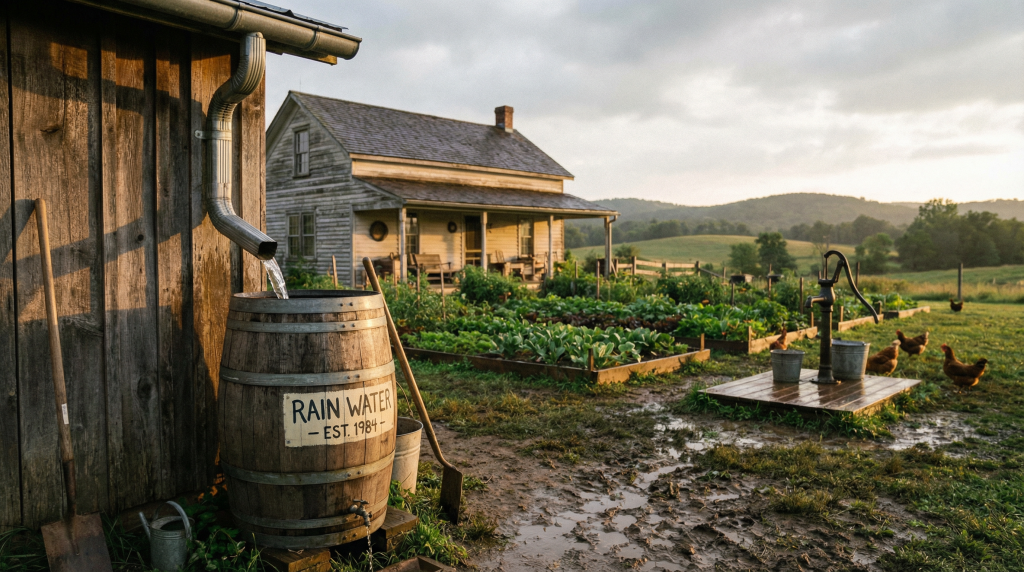
Rainwater harvesting is the simplest, most effective first step toward water autonomy. The concept is ancient: capture the water that falls freely from the sky and store it for future use. For the cost of some gutters and a barrel, you can create a buffer that protects you from short-term disruptions.
The Basic Setup (Cost: $150 – $400)
- Collection Surface: Your roof is the primary collector. Metal, slate, or tile roofs are ideal. Avoid asphalt shingles if possible for potable water, as they can leach petroleum compounds.
- Gutters and Downspouts: Standard aluminum or PVC gutters will channel the water.
- First-Flush Diverter: This is a critical component. The first few gallons of rainfall wash debris, bird droppings, and pollutants off your roof. A first-flush diverter automatically discards this initial, dirty water before the clean water enters your storage.
- Storage Tank: A 55-gallon food-grade rain barrel is a good start. For serious homesteads, consider a 500 or 1,000-gallon cistern.
Actionable Steps
- Calculate Your Potential: A 1,000-square-foot roof can capture approximately 623 gallons of water for every inch of rain.
- Install Gutters and Downspouts: Ensure they are clean and have a proper slope toward your collection point.
- Install the First-Flush Diverter: This is a non-negotiable for safe water. Kits are available online for under $50.
- Connect to Your Barrel/Cistern: Ensure all connections are sealed and light-proof to prevent algae growth.
This basic system provides non-potable water for your garden, livestock, and cleaning. To make it drinkable, you need to add filtration.
Section 2: From Barrel to Bottle — The Path to Potable Water
Raw rainwater is not safe to drink without treatment. A multi-stage filtration system is required to remove sediment, bacteria, and viruses.
The Filtration Train (Cost: $300 – $800)
- Sediment Filter (5-micron): This is the first stage, removing larger particles like sand, silt, and organic debris.
- Carbon Block Filter (0.5-micron): This second stage removes chemicals, pesticides, and improves the taste and odor of the water.
- UV Sterilizer: This is the final and most crucial step for potable water. An ultraviolet light sterilizer kills 99.99% of bacteria, viruses, and protozoa without adding any chemicals to your water.
Actionable Steps
- Pump Installation: You’ll need a small on-demand pump to move water from your storage tank through the filters. A 12V DC pump can run off a small solar setup, keeping your water flowing even when the grid is down.
- Filter Assembly: Mount the filters in series, starting with the sediment filter, then the carbon block, and finally the UV sterilizer.
- Connect to a Dedicated Faucet: Install a separate faucet in your kitchen for your clean, off-grid water to avoid cross-contamination.
With this system, you have created a micro-utility. You are no longer dependent on a fragile municipal system for your most essential need.
Want to take your energy independence to the next level? Discover the ancient invention that’s wiping out power bills for homesteaders across America →
Section 3: The Ultimate Backup — The Manual Hand Pump
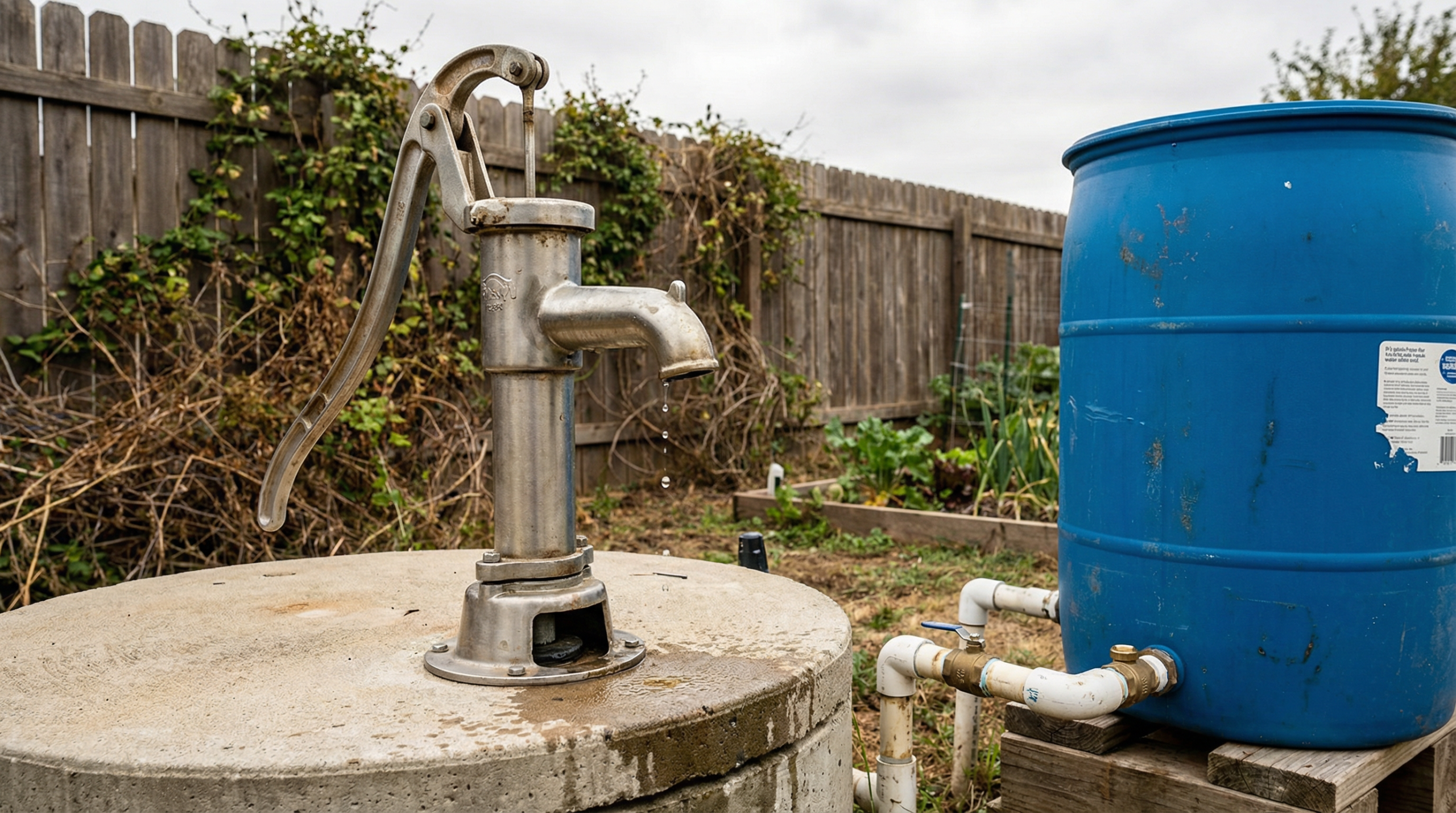
What happens if your electric pump fails? Or your solar panels are damaged? The ultimate level of resilience is a manual hand pump. If you have a well on your property, a hand pump is an essential, non-negotiable backup.
The Bison or Simple Pump (Cost: $1,500 – $3,000)
These aren’t the decorative cast-iron pumps from your grandmother’s garden. Modern hand pumps are made of stainless steel and can be installed alongside your existing submersible electric pump. They can draw water from depths of 300 feet or more with relative ease.
Why This is Non-Negotiable
- Grid-Down Proof: It requires no electricity. Period.
- EMP-Proof: An electromagnetic pulse won’t affect a simple mechanical device.
- Generational Reliability: These pumps are built to last for decades with minimal maintenance.
Installing a deep-well hand pump is a significant investment, but it is the final word in water security. It ensures that no matter what happens to the outside world, your family will have access to clean, fresh water.
Your Ark in the Age of Abdication
The Vikings who survived the end of their empire were the ones who could feed and water themselves. They didn’t wait for a political solution; they built a practical one.
Your homestead is your modern-day ark. While the world outside is consumed with the drama of retreating empires and shifting alliances, you can be quietly building a legacy of true independence.
Start with a single rain barrel. Then add a filter. Then plan for a cistern and a hand pump. Every step you take is a declaration of your own sovereignty.
Noah didn’t wait for the rain to start building the ark. The storm is on the horizon. It’s time to get to work.
Also From the Gravitational Portfolio
While you’re building your water independence, don’t overlook the bigger picture. American Downfall is tracking the geopolitical shifts that make this work urgent. Self Reliance Report has the tools and gear reviews to equip your homestead. And 4ft Farm Blueprint shows you how to maximize your food production in any space.
The real wealth isn’t in the global system. It never was. It’s right here, on your land, in your hands.